
At a roadside inspection, one of the first documents an inspector now asks for is the safety data sheet, and it has to be in the vehicle for the whole journey. Under an amendment that took effect in Turkey on 17 October 2026, companies that ship and carry dangerous chemicals must keep the safety data sheet (SDS/MSDS) on board in paper or digital form. We met this requirement in our own shipments with a QR code on every package rather than a binder. This article explains what the rule actually says, who is responsible and how we built a QR-coded system in four steps.
What Changed on 17 October 2026?
Turkey's Ministry of Transport and Infrastructure published the amending regulation to the Regulation on the Road Transport of Dangerous Goods in the Official Gazette of 17 October 2026, issue 33403. It amends several articles of the main regulation (Official Gazette of 18 June 2022, issue 31870). The provision that matters most for the chemical industry is Article 32, paragraph 3.
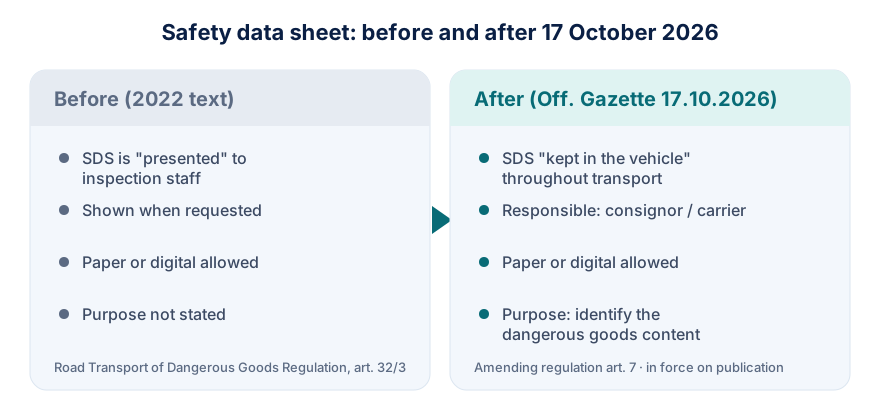
Previously, that paragraph required the consignor/carrier to present a KKDİK-compliant safety data sheet, in paper or digital form, to inspection staff. The amendment rewrote two things:
- It added a purpose: the sheet is kept so that the dangerous goods content can be identified.
- "Must present to inspection staff" became "keeps in the vehicle throughout transport".
The sheet is no longer a document fetched on request; it must be ready in the vehicle while the load is on the road. Under Article 10 of the amending regulation, the change entered into force on publication, with no transition period.
Official texts (in Turkish):
- Amending regulation, Official Gazette of 17 October 2026, issue 33403
- Regulation on the Road Transport of Dangerous Goods (mevzuat.gov.tr)
Who Is Responsible: Consignor or Carrier?
Most news coverage described the change as "a new obligation for carriers". The regulation, however, says consignor/carrier, and the amended penalty article (36) sets separate administrative fines for the consignor and the carrier for breaching this paragraph. For a company that ships chemicals the message is clear: leaving the sheet to the haulier does not remove the risk.
Two details are often missed:
- The sheet must comply with KKDİK, Turkey's REACH-equivalent regulation, and be in Turkish. We cover this in our KKDİK, REACH and MSDS guide.
- The sheet must match the product on board. In a mixed load, each product needs its own sheet, and "which drum belongs to which sheet?" must be answerable in seconds.
For other documentation and packaging rules see our article on chemical storage and ADR transport, and for hazard pictograms our GHS/CLP labelling guide.
Paper or Digital? The Hidden Cost of the Binder
The regulation accepts both, but they do not perform the same in the field. As a supplier, nearly every problem we see has the same root: paper ages, products change, binders are not updated.
| Criterion | Paper SDS (binder) | QR-coded digital SDS |
|---|---|---|
| Up to date | The copy on board goes stale at the next revision | The scanned sheet is always the latest |
| Mixed loads | A separate copy per product | Every package carries its own code |
| Multi-drop delivery | Sheets may stay at the first stop | The code travels with the package |
| Access at inspection | Finding the right page takes time | Scan the code, the sheet opens |
| Version history | Old copies get lost | Every version archived with its date |
| Cost | Printing and distribution per shipment | The label is printed once |
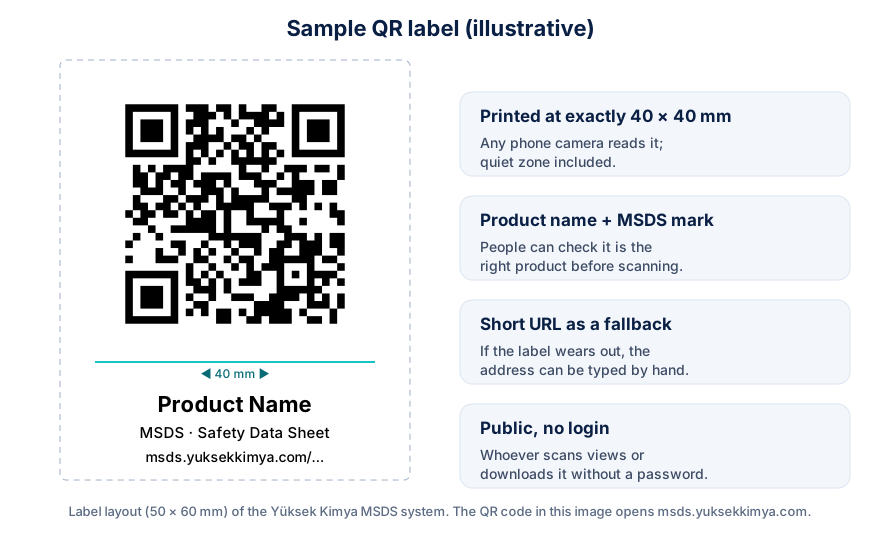
The only thing digital requires is access: the sheet must open during the inspection. That is why it matters that the system needs no login, works on any phone and allows the PDF to be downloaded in advance.
How Does a QR-Coded MSDS Work? Yüksek Kimya's 4-Step System
Following this change, we built and launched a QR-coded MSDS system for every product in our catalogue. It works in four steps:
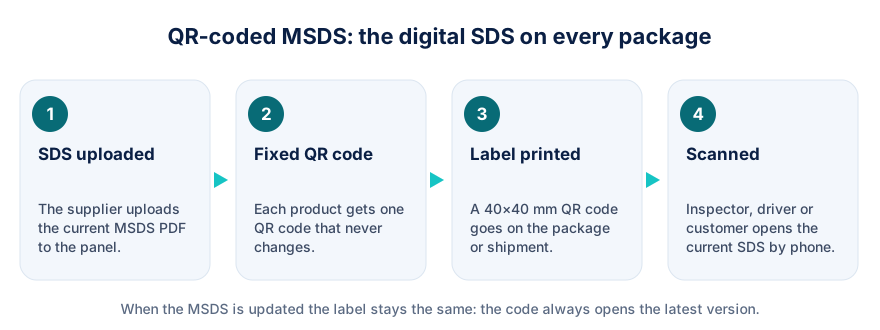
- The safety data sheet is uploaded. The current MSDS PDF of each product goes into the admin panel; hundreds of products can be added at once, matched automatically from file names.
- Each product gets a fixed QR code. The code points to an address for the product that never changes, not to the PDF file. This is the most important design decision.
- The label is printed and applied. The code prints at exactly 40 × 40 mm, one by one on a label printer or in bulk on A4 sheets.
- It is scanned and the current sheet opens. An inspector, driver or customer scans the code with a phone camera and sees the product name and update date. The sheet can be viewed or downloaded in one tap, with no app or password.
We made a few design decisions based on what can go wrong in the field:
- Updating the MSDS never changes the label. The moment a new version is uploaded, every label already in circulation opens it.
- Old versions are never deleted. An audit may ask which version was valid on the shipping date; every version stays archived with its date.
- A code is never reissued to another product. Even if a product is removed, its code is retired, so an old label can never open the wrong product's sheet.
- The panel is private, the sheet is public. Only authorised e-mail addresses can enter the admin panel, while anyone who scans the code sees the sheet without logging in.
The 5 Most Common Mistakes
- Linking the QR code directly to the PDF file. When the sheet is revised the file address changes, and every printed label opens either an outdated sheet or an error page.
- Uploading an old or non-KKDİK-compliant sheet. However well the code works, an unsuitable document does not satisfy the requirement.
- Printing the code too small. "Fit to page" in the print dialog shrinks the code; small or worn codes do not scan next to a tanker. 40 × 40 mm at 100% scale is a safe standard.
- Sending the sheet to the driver's phone by message. Messages get lost, versions blur and the information does not pass on when the driver changes. The document should be tied to the package.
- Sticking the code only on the vehicle. In multi-drop deliveries packages leave the vehicle; the code belongs on every package.
For routes with poor coverage: because the system allows PDF downloads, drivers can save the sheets to their phone before departure, so both the code and an offline copy are on board.
Let Us Set Up This System for Your Company
We now offer the system we built for our own catalogue to companies facing the same obligation:
- chemical manufacturers and distributors,
- businesses shipping paint, cleaning and cosmetic raw materials,
- logistics companies carrying dangerous goods.
Setup includes importing your products' MSDSs, preparing a QR code and label template for every product, and training your team on the panel. The system can run on your own domain, and your sheets stay in a panel that belongs to you. We launched our own catalogue within a few days; timing depends on your product count and whether your sheets are ready.
To bring your dangerous goods shipments into line with the new rules using QR codes, contact us or call +90 224 326 27 50, and we will walk you through a live example.
This article is for general information and is not legal advice. For obligations specific to your company, consult your dangerous goods safety adviser.
Frequently Asked Questions
Is it mandatory to keep the safety data sheet in the vehicle in Turkey?
Yes. The amendment published in the Official Gazette of 17 October 2026 (issue 33403) rewrote Article 32(3) of the Regulation on the Road Transport of Dangerous Goods. The consignor/carrier keeps a KKDİK-compliant safety data sheet, in paper or digital form, in the vehicle throughout transport so that the dangerous goods content can be identified. It entered into force on publication.
Is a digital safety data sheet accepted?
Yes. The text explicitly allows the safety data sheet to be kept in paper or digital form. What matters in practice is that the current sheet for the right product can be shown quickly during a roadside inspection, so the digital sheet should be tied to the package and remain accessible when mobile coverage is weak.
Does the regulation require a QR code?
No. The regulation does not mention QR codes; it requires the safety data sheet to be on board in paper or digital form. A QR code is simply the most practical way to put the digital sheet on every package: whoever scans it sees the current sheet for that exact product.
Who is responsible, the consignor or the carrier?
The wording is consignor/carrier, and the penalty article (36) as amended sets separate administrative fines for the consignor and for the carrier when this paragraph is breached. A chemical supplier therefore cannot simply leave the sheet to the haulier.
Do labels need to be reprinted when the MSDS is updated?
Not with a well-designed system. In the system Yüksek Kimya uses, the QR code points to a fixed address for the product, not to a PDF file. When a new version is uploaded, every label already in the field opens the new sheet, and earlier versions stay archived for audits.